
Spenden
- Activities
- About NetAP
- Your help
- Education
- Media


Many millions of animals still die every year in often cruel animal experiments. They are routinely used in research, but also in industry, universities and hospitals. In Switzerland alone, universities and chemical/pharmaceutical companies use hundreds of thousands of animals for their tests every year. Mainly mice, but also dogs, cats, monkeys, birds, sheep, goats and other animals are used.
Animals are usually used in experiments as models for humans, meaning that the findings from the experiment are then transferred to humans. Whether for diseases such as influenza, cancer or dementia, for cleaning products and cosmetics, for the cigarette industry or space travel, there is hardly an area in which animals do not have to suffer for humans. Although Art. 4 para. 2 of the Animal Welfare Act prohibits the (unjustified) torture of animals, little is being done to advance research using alternative methods.
Even if the Federal Veterinary Office glosses over the figures every year and speaks of positive developments, it must not be forgotten that the guarantee of dignity enshrined in the Federal Constitution is violated in all these animals in favour of research.
Consumption of animals in animal experiments in Switzerland according to the Federal Veterinary Office (FVO):
Although particularly cruel, countless animals suffer every year in severity level 3 experiments, i.e. extremely painful, permanently damaging experiments:
But even the often trivialised experiments in severity level 0 cannot really be described as harmless. Feeding experiments are often listed here without mentioning that a significant proportion of the animals themselves are killed in these experiments in order to remove tissue and organs or to use them for training purposes. The killing of animals is wrongly not categorised as stress.
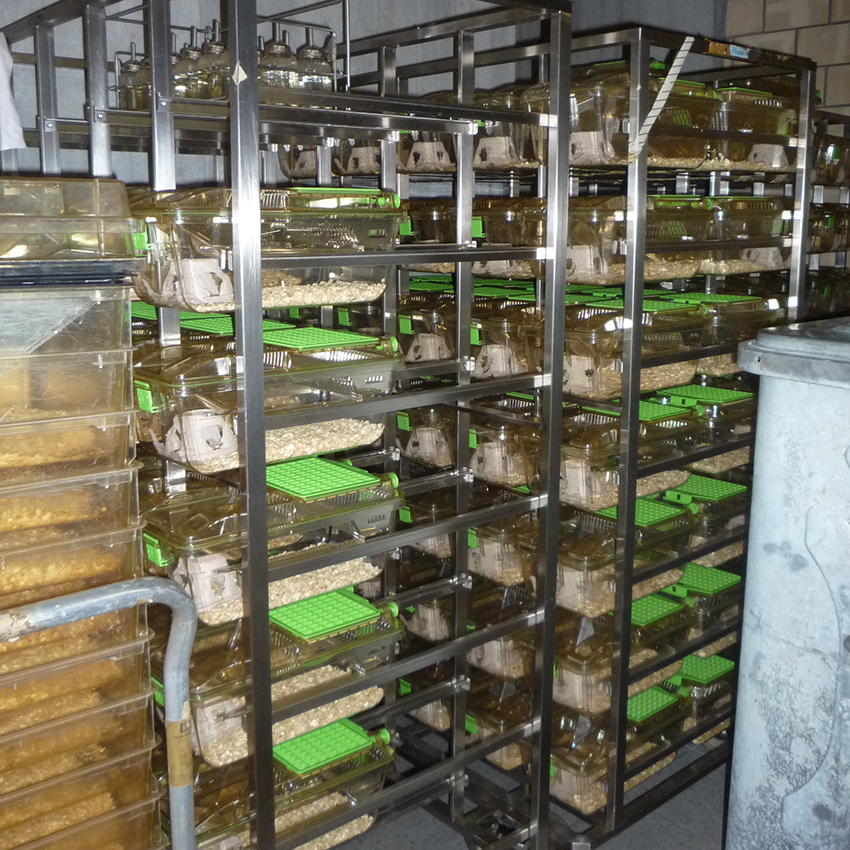
It should also be noted that the care of animals that have to dedicate their lives to research leaves much to be desired. For example, the keeping of mice in small plastic boxes is still permitted, although this has been proven to lead to behavioural disorders.
What is animal testing?
The definition of an animal experiment can be found in the Animal Welfare Act (TSchG).
Art. 3 TSchG states:
Als Tierversuch gilt jede Massnahme, bei der lebende Tiere verwendet werden, mit dem Ziel:
Further important provisions can be found in Art. 10 – 12 of the Animal Welfare Act and from Section 6, Art. 17 – 20.
Art. 17 Restriction to the absolute minimum
Animal experiments that may cause pain, suffering or harm to the animal, cause it fear, significantly impair its general condition or disregard its dignity in any other way must be limited to what is absolutely necessary.
Further information can be found at:
Keine Belastung, Schweregrad 0
Eingriffe und Handlungen, durch die den Tieren keine Schmerzen, Leiden, Schäden oder schwere Angst zugefügt werden. Das Allgemeinbefinden der Tiere wird nicht erheblich beeinträchtigt. Für solche Tierversuche braucht es keine Bewilligung, sie müssen jedoch gemeldet werden.
Beispiele: Blutentnahme für diagnostische Zwecke, Injektion eines Arzneimittels unter die Haut.
Mild stress, severity level 1
Interventions and actions that cause slight, short-term stress (pain or damage).
Examples: Injecting a drug under duress, castration of male animals under anaesthesia.
Moderate distress, severity 2
Interventions and actions that cause moderate, short-term or mild, medium to long-term distress (pain, suffering, harm, severe anxiety or significant impairment of general well-being).
Examples: Surgical treatment of an artificially induced bone fracture in a leg, castration of female animals.
Severe stress, severity level 3
Interventions and actions that cause severe to very severe, or moderate, medium to long-term stress.
Examples: Fatal infectious diseases and cancer, without premature euthanasia.
Animals are subjected to torturous experiments not only for medicine, but also for cleaning agents, cosmetics, cigarettes, Botox, etc. All too often, however, the results are not transferable to humans. There are many better methods for clarifying scientific questions or testing the dangers of substances. We don’t need animal experiments, they are cruel and too often unreliable!
Conclusion: Remember that by leading an unhealthy lifestyle, you are contributing to the death of many animals for the sake of the medication you consume or even to get rid of self-inflicted symptoms of illness. Take as little medication as possible!
Completely avoid cosmetic products that have been tested on animals as finished products or whose raw materials have been tested on animals. When choosing your hairdresser, also make sure that they work with animal-free products. When shopping, consider manufacturers who offer cruelty-free products. There are already apps for smartphones that inform you when shopping which products have been manufactured without animal testing. Ausserdem finden Sie hier eine Liste Herstellern und Produkten die frei von Tierversuchen sind.